Every diagram on OrbitalSolar is drawn here, from regulatory filings and published mission records rather than from stock artwork or company renders. They are released under CC BY 4.0: use them in articles, lessons, papers or slides, including commercially, as long as you credit OrbitalSolar.ai.
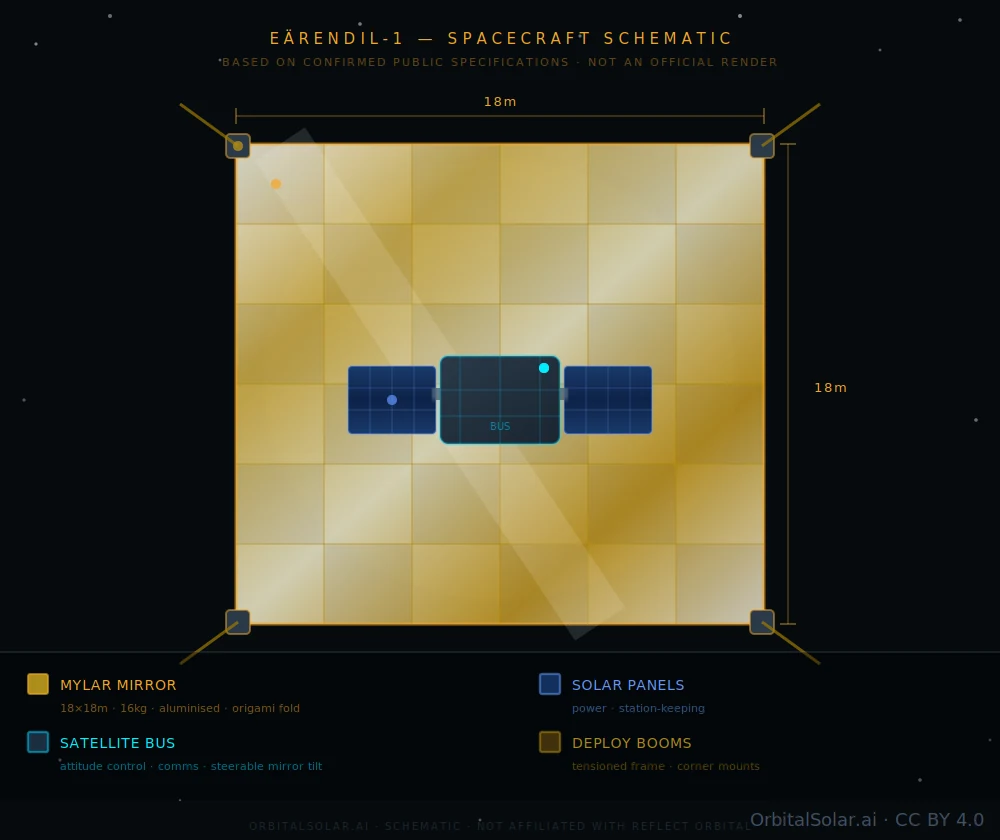
Eärendil-1 has not launched, so no photographs of it exist. The schematic below is built from the specifications in the filings and is labelled as such.
How bright, against things you can judgeLux figures are hard to intuit, so the company’s own published targets are placed beside light levels anyone can judge. The scale is logarithmic because the range spans six orders of magnitude. The 2035 target — 36,000 lux, held for hours — sits between overcast daylight and direct sun.From Reflect Orbital’s roadmap ·
vector version ·
CC BY 4.0 — reuse it anywhere with credit to OrbitalSolar.aiEärendil-1 spacecraft schematicDrawn from the confirmed public specifications in Reflect Orbital’s FCC filings — not an official render, and no photographs exist because the spacecraft has not launched.From Eärendil-1 ·
vector version ·
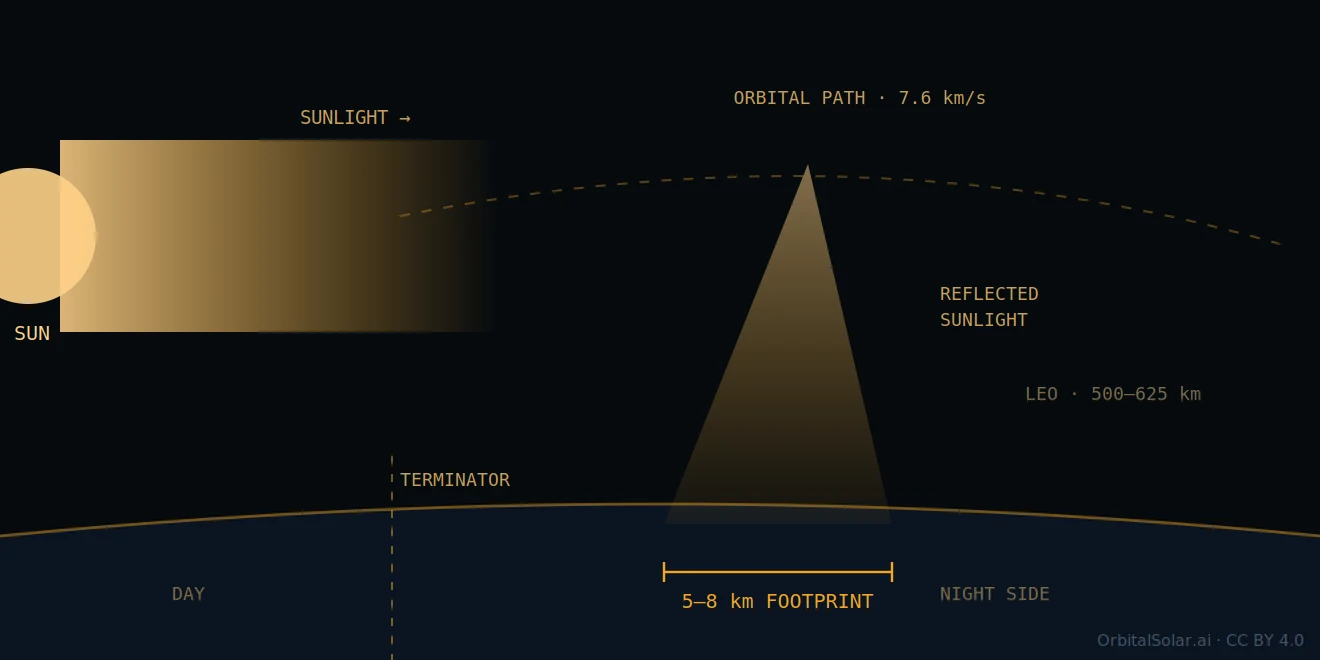
CC BY 4.0 — reuse it anywhere with credit to OrbitalSolar.aiHow a space mirror works, in one pictureThe whole idea in one view: the mirror is still in sunlight while the ground below is already dark, and the reflected patch is a few kilometres wide and moving at orbital speed. The technical version of the same geometry is above.From What is a space mirror? ·
vector version ·
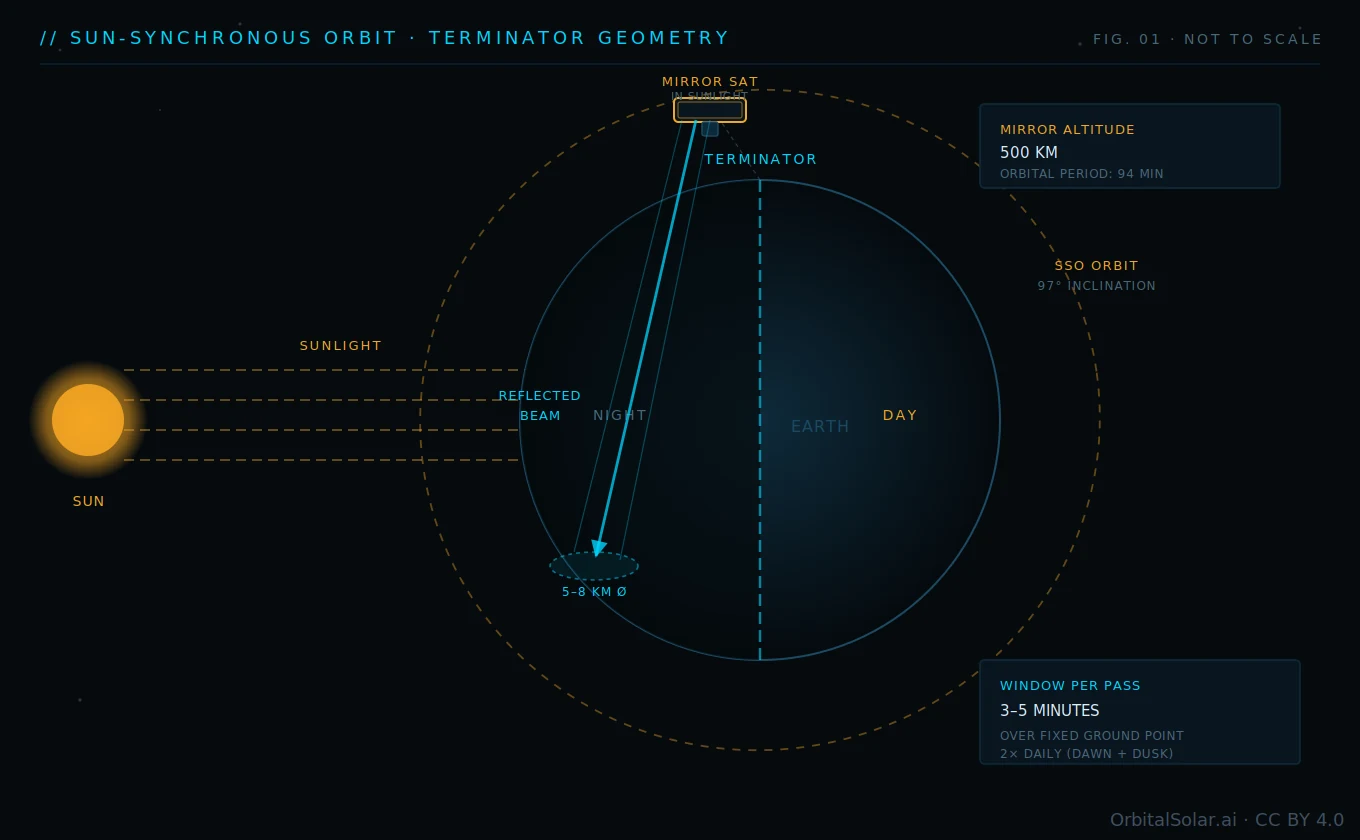
CC BY 4.0 — reuse it anywhere with credit to OrbitalSolar.aiWhy a space mirror only works at dawn and duskA mirror can only light a place that is dark while the mirror itself is still in sunlight. That geometry confines the service to the hour after dusk and before dawn, and to a few minutes per pass. The figures shown are the general sun-synchronous case — 500 km at 97°, a 94-minute period. Eärendil-1 itself flies higher and less inclined, at 625 km and 88°.From Orbital mechanics of space mirrors ·
vector version ·
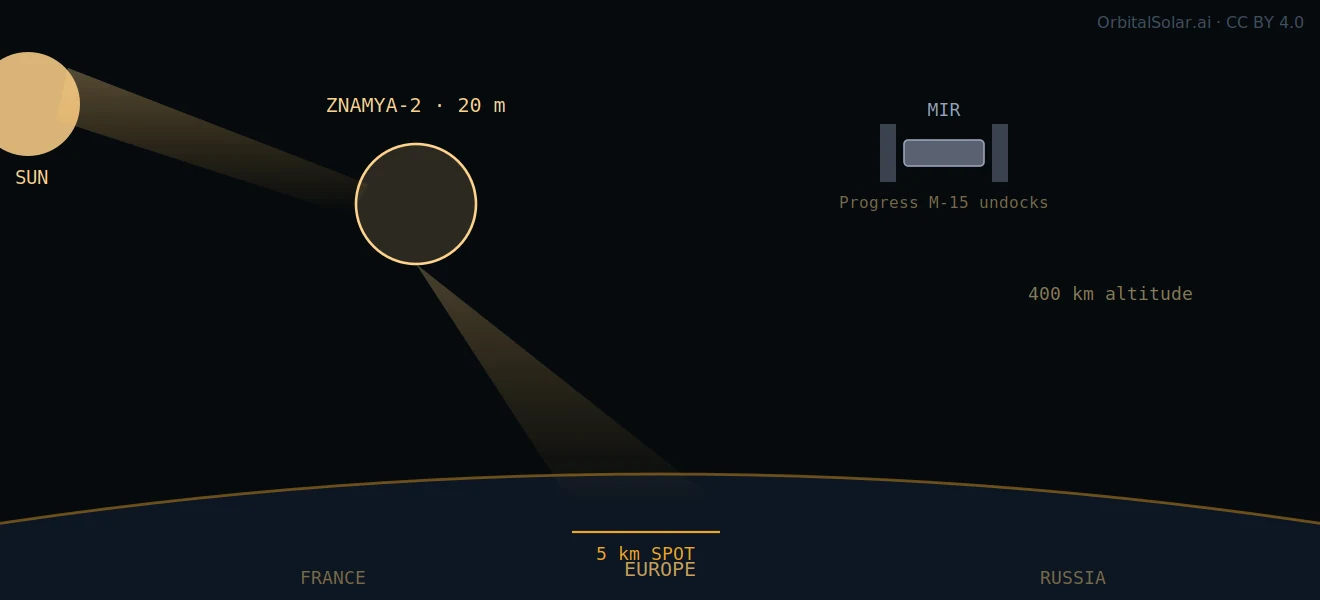
CC BY 4.0 — reuse it anywhere with credit to OrbitalSolar.aiZnamya-2, 1993 — the first orbital mirrorThe only orbital mirror ever successfully deployed. Znamya-2 cast a roughly five-kilometre spot across Europe in February 1993; the larger Znamya-2.5 failed during deployment in 1999 and nothing has flown since.From Znamya ·
vector version ·
CC BY 4.0 — reuse it anywhere with credit to OrbitalSolar.ai